Thessaloniki International Fair 2026 - Honoured Country Japan
2026/6/5
Ambassador’s message
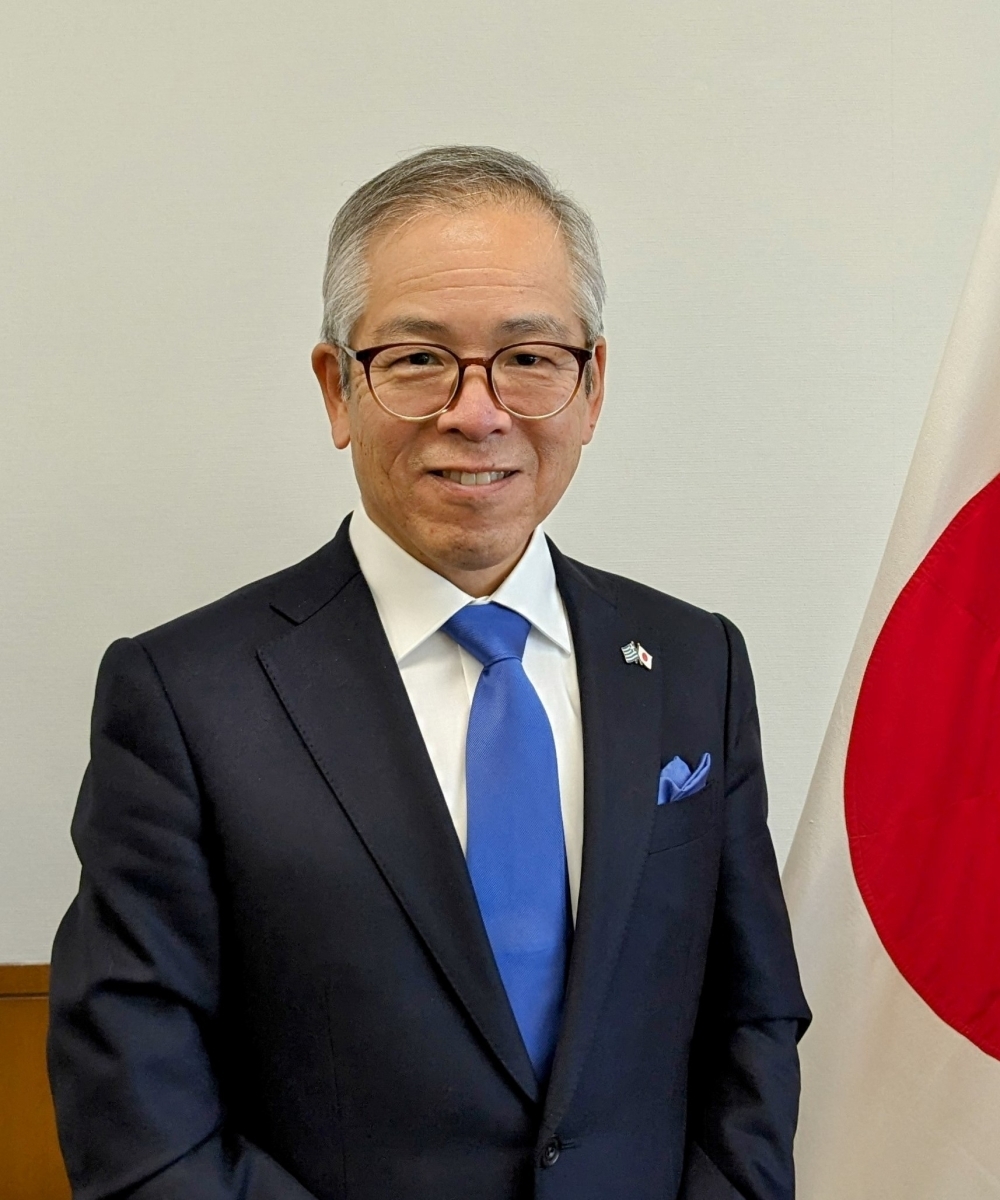
Γεια σας, ονομάζομαι Koichi ITO και είμαι ο Πρέσβης της Ιαπωνίας στην Ελλάδα.
It is a great pleasure and honour for me and all the Embassy staff to participate in the 90th Thessaloniki International Fair. This year, Japan’s participation, as the Honored Country, is further highlighted by the centennial anniversary of the first TIF held in 1926.
Seizing this opportunity, we are proud to present Japan’s traditions and culture, TAKUMI in the wonderful city of Thessaloniki. The TAKUMI philosophy is reflected in many aspects of private and business life. Products are crafted not just to be efficient but also a feast for the eyes. Appreciation for beauty is not limited to traditional items. Modern products can also be designed with this philosophy in mind. Japanese companies understand that even the smallest details deserve attention, as they can make a significant difference and change the game.
Takumi encapsulates the commitment to excellence and the willingness to exceed expectations. As artificial intelligence, automation, and digital platforms reshape industries, the human touch remains essential, representing our values and mindset. It is about focusing on long-term success and achieving sustainability.
I do hope that this event will build a strong bridge for both private and business sectors. I look forward to seeing you at the Thessaloniki International Fair and to further deepening our bilateral relationship.
Koichi ITO
Ambassador of Japan to Greece
It is a great pleasure and honour for me and all the Embassy staff to participate in the 90th Thessaloniki International Fair. This year, Japan’s participation, as the Honored Country, is further highlighted by the centennial anniversary of the first TIF held in 1926.
Seizing this opportunity, we are proud to present Japan’s traditions and culture, TAKUMI in the wonderful city of Thessaloniki. The TAKUMI philosophy is reflected in many aspects of private and business life. Products are crafted not just to be efficient but also a feast for the eyes. Appreciation for beauty is not limited to traditional items. Modern products can also be designed with this philosophy in mind. Japanese companies understand that even the smallest details deserve attention, as they can make a significant difference and change the game.
Takumi encapsulates the commitment to excellence and the willingness to exceed expectations. As artificial intelligence, automation, and digital platforms reshape industries, the human touch remains essential, representing our values and mindset. It is about focusing on long-term success and achieving sustainability.
I do hope that this event will build a strong bridge for both private and business sectors. I look forward to seeing you at the Thessaloniki International Fair and to further deepening our bilateral relationship.
Koichi ITO
Ambassador of Japan to Greece
Country Fact Sheet
 Geospatial Information Authority of Japan (GSI)
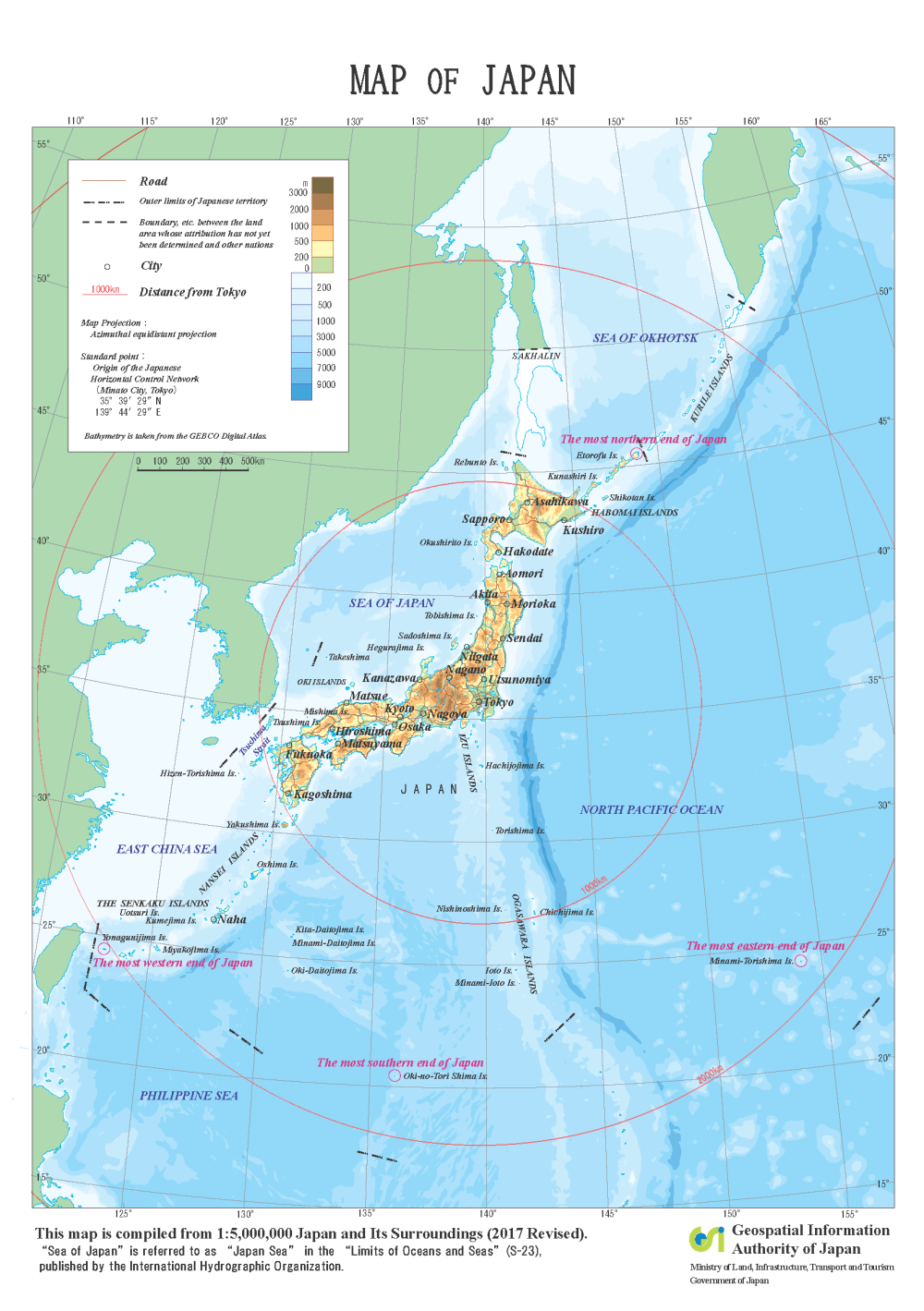
Japan is an East Asian archipelago nation made up of 14.125 islands1 (as of 2023), with a population of approximately 122.9 million2 (as of 2026). While most visitors to Japan are familiar with the four largest islands, Hokkaido, Honshu, Shikoku and Kyushu, approximately 417 of them are inhabited3. Nearly half of Japan’s population is concentrated in the three major metropolitan areas: the Tokyo, Osaka, and Nagoya areas.
Japan is internationally recognized for its exceptionally low crime rates4, particularly regarding violent crime. According to international statistics (as of 2024), its intentional homicide rate remains among the lowest in the world, reflecting a high level of public safety and social stability.
Japan is located west of the Pacific Ocean in the Northern Hemisphere. In terms of latitude, Japan coincides approximately with the Mediterranean Sea and with the city of Los Angeles in North America. Japan’s total land area is about 378,000 sq. kilometers; it is thus approximately the same size as Germany, Finland, Vietnam, or Malaysia.
Japan is internationally recognized for its exceptionally low crime rates4, particularly regarding violent crime. According to international statistics (as of 2024), its intentional homicide rate remains among the lowest in the world, reflecting a high level of public safety and social stability.
Japan is located west of the Pacific Ocean in the Northern Hemisphere. In terms of latitude, Japan coincides approximately with the Mediterranean Sea and with the city of Los Angeles in North America. Japan’s total land area is about 378,000 sq. kilometers; it is thus approximately the same size as Germany, Finland, Vietnam, or Malaysia.
The national flag of Japan, known as the “Hinomaru,” has been used for centuries as a symbol of the country’s identity and heritage, with its red sun emblem reflecting Japan’s long-standing association with the rising sun.
The language of Japan is Japanese. Many people practice customs from both Shintoism and Buddhism. Japan has a constitutional monarchy with a parliamentary system of government, known as the National Diet of Japan. Under the Constitution of Japan, the Emperor is the symbol of the State and of the unity of the People, while the Prime Minister is the head of government.
Japan’s currency, the yen (¥), has been a central part of the country’s modern economic history since its introduction in the late 19th century during the Meiji era, when Japan reformed and standardized its monetary system as part of its rapid modernization. Today, the yen remains one of the world’s most widely traded and recognized currencies.
As of 2025 (IMF, World Economic Database), Japan has the world’s fourth-largest economy and plays a major role in global trade, technology, and industry5. Despite having limited natural resources, Japan has built a highly advanced economy through innovation, manufacturing, and strong international trade partnerships. Its economic relationship with Greece is particularly important in the shipping sector, where the long-standing cooperation between Japanese shipbuilders and the Greek maritime industry has strengthened commercial ties between the two countries. Additionally, Japan remains one of the world’s leading producers of fishing products due to its extensive maritime area and strong connection to the sea.
[1] Geospatial Information Authority of Japan (GSI), Ministry of Land, Infrastructure, Transport and Tourism. "Islands of Japan" (2023).
[2] Statistics Bureau, Ministry of Internal Affairs and Communications, Government of Japan. "Population Estimates" (January 2026)
[3] Center for Research and Promotion of Japanese Islands (Nijinet). "Basic Guide to Inhabited Islands" (Based on the 2020 National Census)
[4] United Nations Office on Drugs and Crime (UNODC). Global Study on Homicide 2023 / Global Homicide Statistics (Data current as of 2024)
[5] International Monetary Fund (IMF). World Economic Outlook Database (April 2025 Edition)
The language of Japan is Japanese. Many people practice customs from both Shintoism and Buddhism. Japan has a constitutional monarchy with a parliamentary system of government, known as the National Diet of Japan. Under the Constitution of Japan, the Emperor is the symbol of the State and of the unity of the People, while the Prime Minister is the head of government.
Japan’s currency, the yen (¥), has been a central part of the country’s modern economic history since its introduction in the late 19th century during the Meiji era, when Japan reformed and standardized its monetary system as part of its rapid modernization. Today, the yen remains one of the world’s most widely traded and recognized currencies.
As of 2025 (IMF, World Economic Database), Japan has the world’s fourth-largest economy and plays a major role in global trade, technology, and industry5. Despite having limited natural resources, Japan has built a highly advanced economy through innovation, manufacturing, and strong international trade partnerships. Its economic relationship with Greece is particularly important in the shipping sector, where the long-standing cooperation between Japanese shipbuilders and the Greek maritime industry has strengthened commercial ties between the two countries. Additionally, Japan remains one of the world’s leading producers of fishing products due to its extensive maritime area and strong connection to the sea.
[1] Geospatial Information Authority of Japan (GSI), Ministry of Land, Infrastructure, Transport and Tourism. "Islands of Japan" (2023).
[2] Statistics Bureau, Ministry of Internal Affairs and Communications, Government of Japan. "Population Estimates" (January 2026)
[3] Center for Research and Promotion of Japanese Islands (Nijinet). "Basic Guide to Inhabited Islands" (Based on the 2020 National Census)
[4] United Nations Office on Drugs and Crime (UNODC). Global Study on Homicide 2023 / Global Homicide Statistics (Data current as of 2024)
[5] International Monetary Fund (IMF). World Economic Outlook Database (April 2025 Edition)

Mission and Theme [TAKUMI]
As TIF2026 celebrates its 100th year, Japan stands at a crossroads, bridging the past century and the next. We invite you to join us in discovering our rich heritage and innovative spirit, as we aim to foster collaboration at this significant event. Visitors to the Pavilion 13 will have the unique opportunity to explore the vast landscape of Japanese craftsmanship across a diverse array of fields through our core theme TAKUMI.
The exhibition will highlight the spirit of TAKUMI (craftmanship) a deep-rooted tradition that embodies the pursuit of simplicity and beauty through perfectionism. This value is at the center of flawless work of art, encompassing the wisdom passed down through generations to shape advanced technology, the compassion born from sensitivity and mindfulness in sustainable infrastructure, and the essential driving force that inspires continuous innovation in the future of mobility and tourism.
TAKUMI will be the foundational theme, from the venue architecture and program structure to the thematic zones of the exhibition exhibition (1. Wisdom - Digital, Pharmaceuticals, 2. Compassion - Energy, Infrastructure, 3-. Drive Shipping, Automotive)
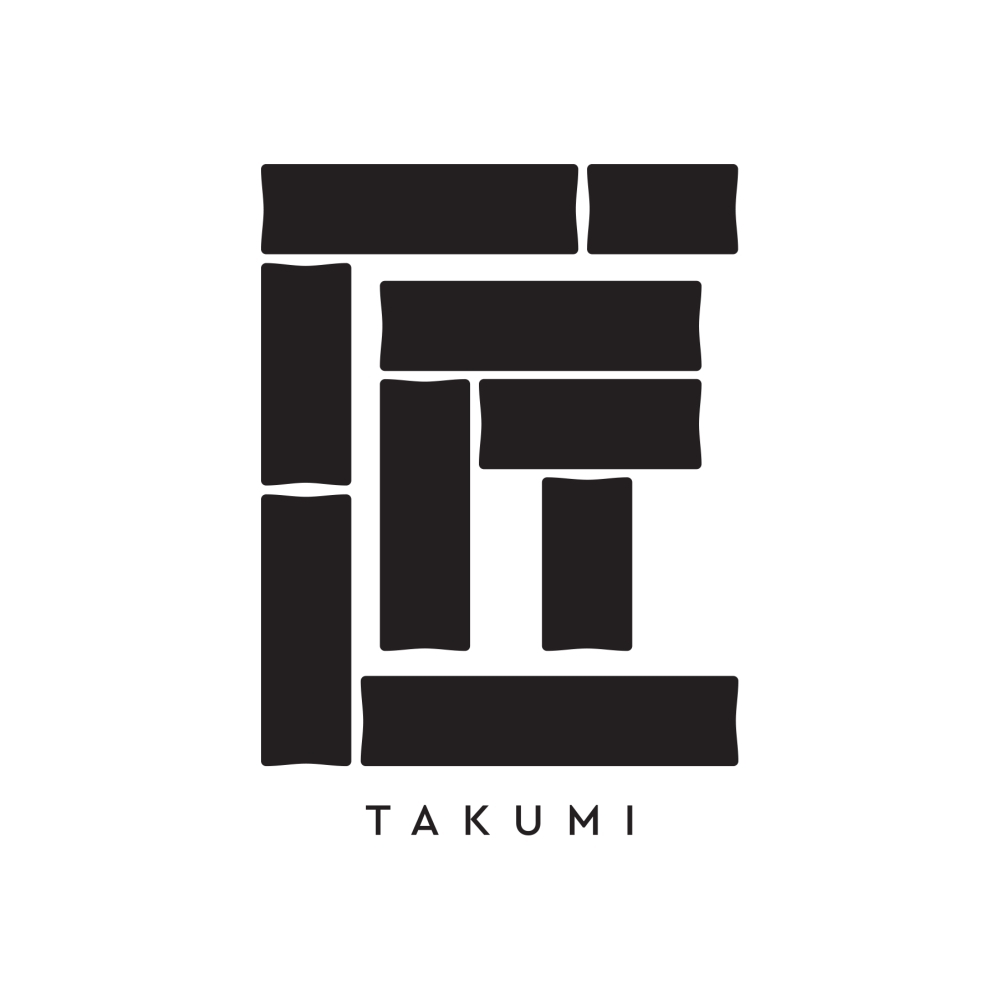
The TAKUMI logo is built upon the structural essence of the kanji 匠, which represents mastery and refined craftsmanship. Rather than depicting the character literally, the design abstracts its construction into independent, balanced elements that evoke assembled parts, materials, and architectural logic. The composition reflects the principles of Takumi: precision, simplicity, and respect for process. Subtle, calculated curves introduce a human presence acknowledging that craftsmanship is not detached from the maker but the result of knowledge applied with care and restraint. The mark is intentionally quiet and non‑decorative, allowing it to function across cultural, architectural, and institutional contexts while maintaining a strong and enduring identity.
Created by Marita Dolka, a Visual Identity Designer based in Greece following a competition held by the Embassy of Japan in Greece. She holds a BSc in Multimedia Technology and Design and an MA in Design and Branding Strategy, along with postgraduate studies in the Department of Cultural Technology and Communication.
In 2006, she represented Greece in “The 18th Ship for the World Youth” program, an experience that deepened her appreciation for Japanese culture and values. Alongside her freelance design practice, Marita runs her own retail business — a bookstore and stationery shop — which informs her practical and human-centered approach to branding.
As the creator of the TAKUMI logo, she drew inspiration from the Japanese philosophy of craftsmanship, combining geometric clarity with organic balance to reflect precision, harmony, and respect for tradition.
Japan – Key Economic Indicators
Key Industries6:
Automobile, electronics and semiconductors & infrastructure (energy, climate control, transportation), R&D (digital solutions, pharmaceuticals, electronic devices), shipbuilding and tourism among others.
Trade Relations with Greece7:
Japan exports transportation equipment to Greece, including automobiles, motorcycles, and train operation systems.
Japan’s imports from Greece are dominated by tobacco and agricultural products, especially olive oil since 2018
Strengthening Bilateral Framework:
Shipping remains a cornerstone of the Greece–Japan relationship for over 70 years
Relations have deepened through the Japan–EU Economic Partnership Agreement (2019), the declaration of the Japan–Greece Strategic Partnership (2023), and the Japan–Greece Tax Treaty (2024)
Emerging cooperation in energy, innovative medicine, and technological devices and services is strengthening the bilateral relationship.
[6] Ministry of Economy, Trade and Industry (METI), Government of Japan. White Paper on International Economy and Trade
[7] Ministry of Finance, Government of Japan. Trade Statistics of Japan (Annual Bilateral Trade Data between Japan and the Hellenic Republic)
Automobile, electronics and semiconductors & infrastructure (energy, climate control, transportation), R&D (digital solutions, pharmaceuticals, electronic devices), shipbuilding and tourism among others.
Trade Relations with Greece7:
Japan exports transportation equipment to Greece, including automobiles, motorcycles, and train operation systems.
Japan’s imports from Greece are dominated by tobacco and agricultural products, especially olive oil since 2018
Strengthening Bilateral Framework:
Shipping remains a cornerstone of the Greece–Japan relationship for over 70 years
Relations have deepened through the Japan–EU Economic Partnership Agreement (2019), the declaration of the Japan–Greece Strategic Partnership (2023), and the Japan–Greece Tax Treaty (2024)
Emerging cooperation in energy, innovative medicine, and technological devices and services is strengthening the bilateral relationship.
| Indicator | Value |
|---|---|
| Nominal GDP (billion units) | ¥ 624,492 (~€3,372) |
| Nominal GDP per Capita (units) | ¥ 5,065,194 (~€27,352) |
| Real GDP Growth (%) | 0.55 |
| Inflation Rate (%) | 2.4 |
| Unemployment Rate (%) | 2.6 |
| Government Revenue (billion units) | ¥ 229,294 (~€1,238) |
| Government Expenditure (billion units) | ¥ 247,096 (~€1,334) |
International Monetary Fund (IMF). World Economic Outlook Database (April 2025 Edition)
[7] Ministry of Finance, Government of Japan. Trade Statistics of Japan (Annual Bilateral Trade Data between Japan and the Hellenic Republic)
Agreements & Strategic Developments
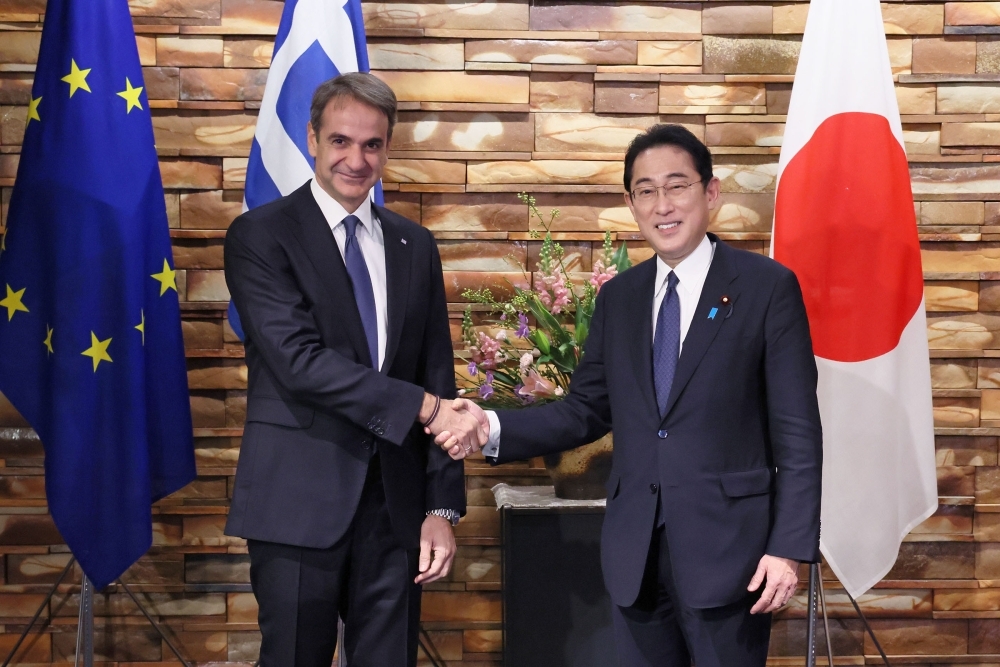 Cabinet Public Affairs Office, Government of Japan
- Japan-EU Economic Partnership Agreement (EPA) https://www.mofa.go.jp/ecm/ie/page4e_000875.h tml
- Japan-Greece Summit Meeting and Working Dinner https://www.mofa.go.jp/erp/c_see/gr/page4e_001326.html
- Joint Statement on Strategic Partnership between the Government of Japan and the Government of the Hellenic Republic, on the Occasion of the Meeting between the Prime Minister of Japan, Mr. Kishida Fumio and the Prime Minister of the Hellenic Republic, Mr. Kyriakos Mitsotakis https://www.mofa.go.jp/files/100452610.pdf
- Entry into force of the Tax Convention between Japan and the Hellenic Republi https://www.mofa.go.jp/press/release/pressite_000001_00711.html